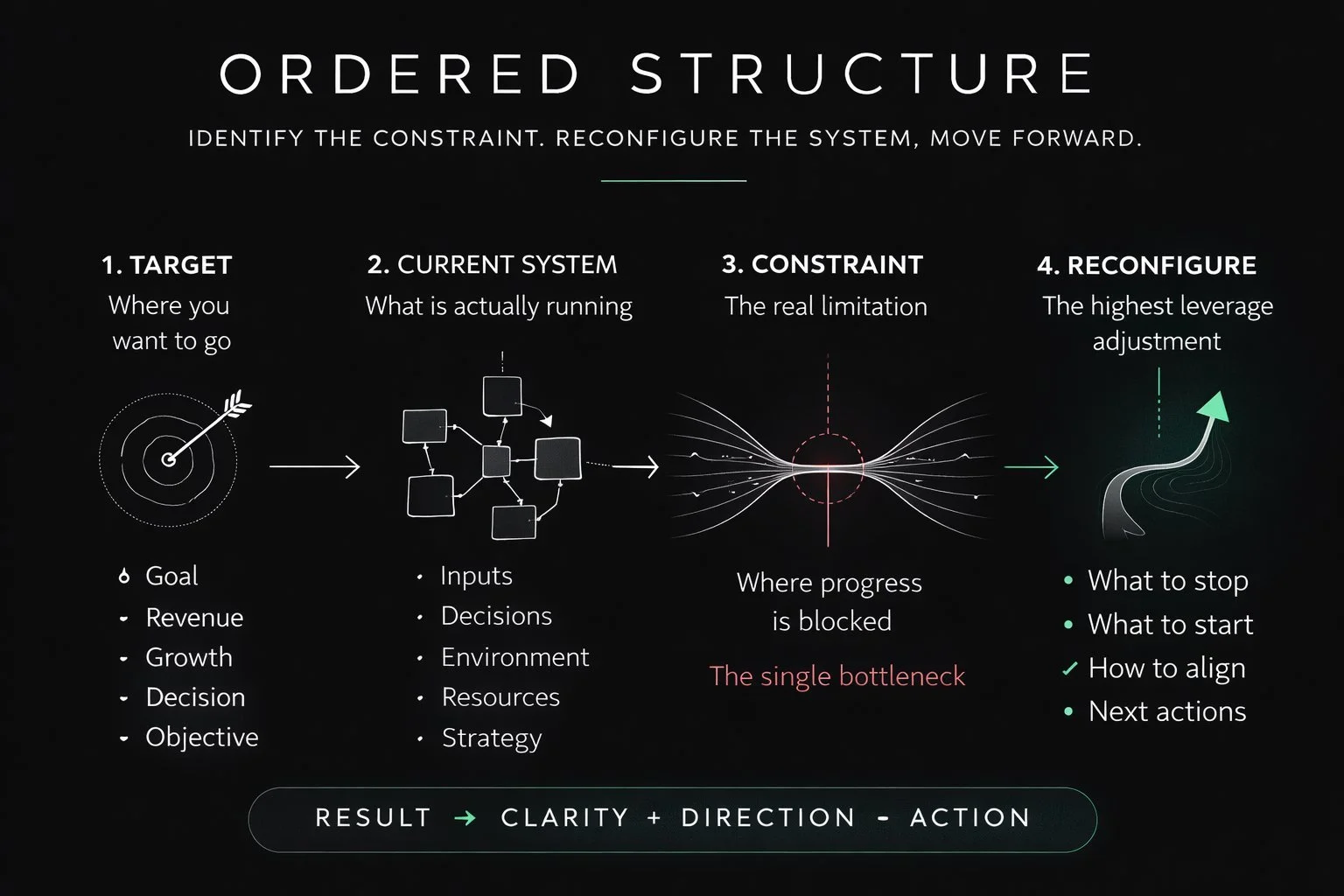
Structural Constraints
Many persistent problems are not caused by lack of effort, motivation, or information.
They persist because the structure producing the results has not been examined clearly.
In most systems, progress is limited by a single structural constraint.
Until that constraint is identified, additional effort often produces little change.
Founders frequently respond to stalled progress by pushing harder—adding more activity, new tactics, or additional resources.
But if the constraint remains unchanged, the system continues producing the same outcome.
What Is a Structural Constraint?
A structural constraint is the point within a system that limits its ability to reach a goal.
Every system produces outcomes based on its structure.
Examples of structural constraints include:
A sales process that limits conversion
Operational capacity that restricts growth
Resource allocation that slows execution
Decision structures that create friction
Until the constraint is identified, improvements made elsewhere in the system have limited impact.
Common Patterns Observed in Stalled Revenue Systems
1. Lead Flow Constraint
Not enough qualified people entering the system.
Symptoms:
Traffic or inbound leads are low
Sales team has idle time
Conversion rates are decent but revenue still flat
Typical fix:
Focus on one reliable acquisition channel and increase volume before optimizing anything else.
2. Conversion Constraint
People are entering the system but not becoming customers.
Symptoms:
Plenty of traffic or leads
Low close rate or signup-to-purchase rate
Prospects show interest but drop off
Typical fix:
Adjust the sales process, messaging, onboarding, or trust signals.
3. Activation / Value Realization Constraint
Users sign up or buy but never reach the product’s core value.
Common in SaaS.
Symptoms:
High signup numbers
Low retention or engagement
Users abandon the product quickly
Typical fix:
Improve onboarding so users experience the key benefit quickly.
4. Pricing / Average Order Value Constraint
Customers buy, but the value per transaction is too small.
Symptoms:
Good conversion rates
Many customers
Revenue still lower than expected
Typical fix:
Increase pricing, introduce tiers, bundles, or upsells.
5. Retention Constraint
Customers leave too quickly.
Symptoms:
Sales happen but churn is high
Revenue constantly resets each month
Typical fix:
Improve product quality, support, or long-term value.
6. Capacity Constraint
Demand exists, but the business cannot fulfill more volume.
Symptoms:
Long delivery times
Overloaded team
Sales slowed intentionally
Typical fix:
Improve systems, hire help, automate processes, or simplify the offer.
7. Founder Focus Constraint
The business system is fragmented because leadership is spread across too many initiatives.
Symptoms:
Many projects running simultaneously
No single revenue lever getting sustained attention
Activity is high but results are flat
Typical fix:
Identify the one variable most likely to move revenue and concentrate effort there.
Why Constraints Are Difficult to See
When someone operates inside a system every day, certain patterns become invisible.
Assumptions form.
Problems normalize.
Effort increases in familiar directions.
Because of this, many founders continue applying effort to parts of the system that are not actually limiting progress.
The constraint remains unchanged, and the results remain the same.
Why Diagnosis Matters
Identifying the constraint allows effort to be directed precisely where it will produce the greatest change.
Once the structural limitation is clear, the next adjustment often becomes obvious.
Instead of pushing harder across the entire system, effort can be focused where it matters most.
The Ordered Structure Approach
Ordered Structure provides focused diagnostic sessions designed to identify the structural constraint within a system.
The process examines:
The goal being pursued
How the current system operates
Where progress is being restricted
The highest leverage adjustment available
The objective is simple:
Identify the constraint
Remove structural friction
Restore forward motion
If your business has reached a plateau and the constraint is unclear, a diagnostic session can help identify where the system is currently limited.